
Is your family energy worth for wiring kids nervous system?

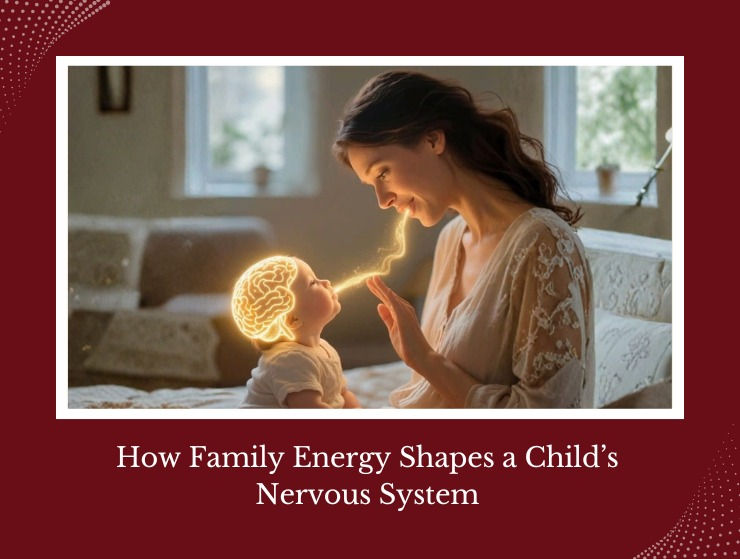
What children absorb long before they can speak
When we talk about children’s development, we often focus on what they learn — alphabets, numbers, skills. But long before learning begins, something deeper is being shaped.
A child’s nervous system.
And the biggest influence on it is not toys, screens, or activities —it is the emotional energy of the family they grow up in.
Children don’t just observe emotions — they absorb them
From the earliest days of life, children are constantly scanning their environment for one thing:
“Am I safe here?”
Their nervous system listens closely to:
The tone of voices around them
How conflicts are handled
Whether emotions are acknowledged or dismissed
How quickly comfort comes when they are distressed
Even when adults think a child is “too young to understand,” the body understands first.
A calm, predictable environment tells the nervous system:
“You can relax. You can explore. You can learn.”
A chaotic or emotionally tense environment tells it:
“Stay alert. Be ready. Something might go wrong.”
Over time, these signals shape how a child responds to the world.
The role of co-regulation: how adults wire calm into children
Young children cannot regulate themselves alone.They borrow regulation from the adults around them.
When a caregiver:
Responds gently to distress
Uses a steady voice
Offers physical and emotional comfort
the child’s nervous system slowly learns:
“This is how calm feels.”
This process is called co-regulation — and it is the foundation of emotional health.
When co-regulation happens consistently, children gradually develop self-regulation:
Better emotional control
Improved focus and learning
Greater resilience during stress
When it is missing or inconsistent, the nervous system remains on high alert.
Stress that shapes the brain — and stress that harms it
Stress itself is not harmful.Children need manageable stress to grow.
What becomes damaging is chronic, unresolved stress — especially when it comes from the family environment.
Examples include:
Frequent shouting or unresolved conflict
Emotional unavailability of caregivers
Unpredictable routines
Ongoing tension, fear, or neglect
This kind of stress keeps the child’s stress-response system activated for too long.Over time, it can affect:
Emotional regulation
Attention and impulse control
Sleep and digestion
Confidence and social relationships
This is often referred to as toxic stress — not because families intend harm, but because the nervous system stays in survival mode.
Early experiences leave biological impressions — but they are not destiny
Research shows that early family experiences can even influence how certain genes are expressed (a process called epigenetics).
This explains why early environments feel so powerful.
But here is the hopeful truth:
The nervous system remains changeable.
Supportive relationships, consistent care, emotional repair, and safe environments can:
Calm an overactive stress response
Build new neural pathways
Restore trust and emotional balance
Children are not fragile — they are adaptable, especially when adults are willing to reflect and grow.
It’s not about perfect families — it’s about repair
No home is calm all the time.No parent gets it right every day.
What matters most is repair.
When adults:
Apologize after losing their temper
Reconnect after conflict
Name emotions instead of ignoring them
they teach children something powerful:
“Relationships can bend without breaking.”
This ability to repair is one of the strongest protectors of a child’s nervous system.
What families can do — starting today
Small, consistent changes make a big difference:
Create predictable routines around sleep, meals, and transitions
Slow down your own nervous system before responding to a child
Validate emotions before correcting behaviour
Reduce exposure to constant conflict
Take caregiver stress seriously — caring for yourself is caring for your child
Children don’t need a perfect environment.They need a safe enough one, filled with emotional availability and understanding.
In conclusion
Family energy is not invisible to children.It becomes part of how they breathe, feel, react, and relate.
When homes offer calm, empathy, and connection, children carry that regulation into classrooms, friendships, and life.
And when families choose awareness over perfection, they give children the greatest gift of all:
A nervous system that feels safe enough to grow.


Comments